
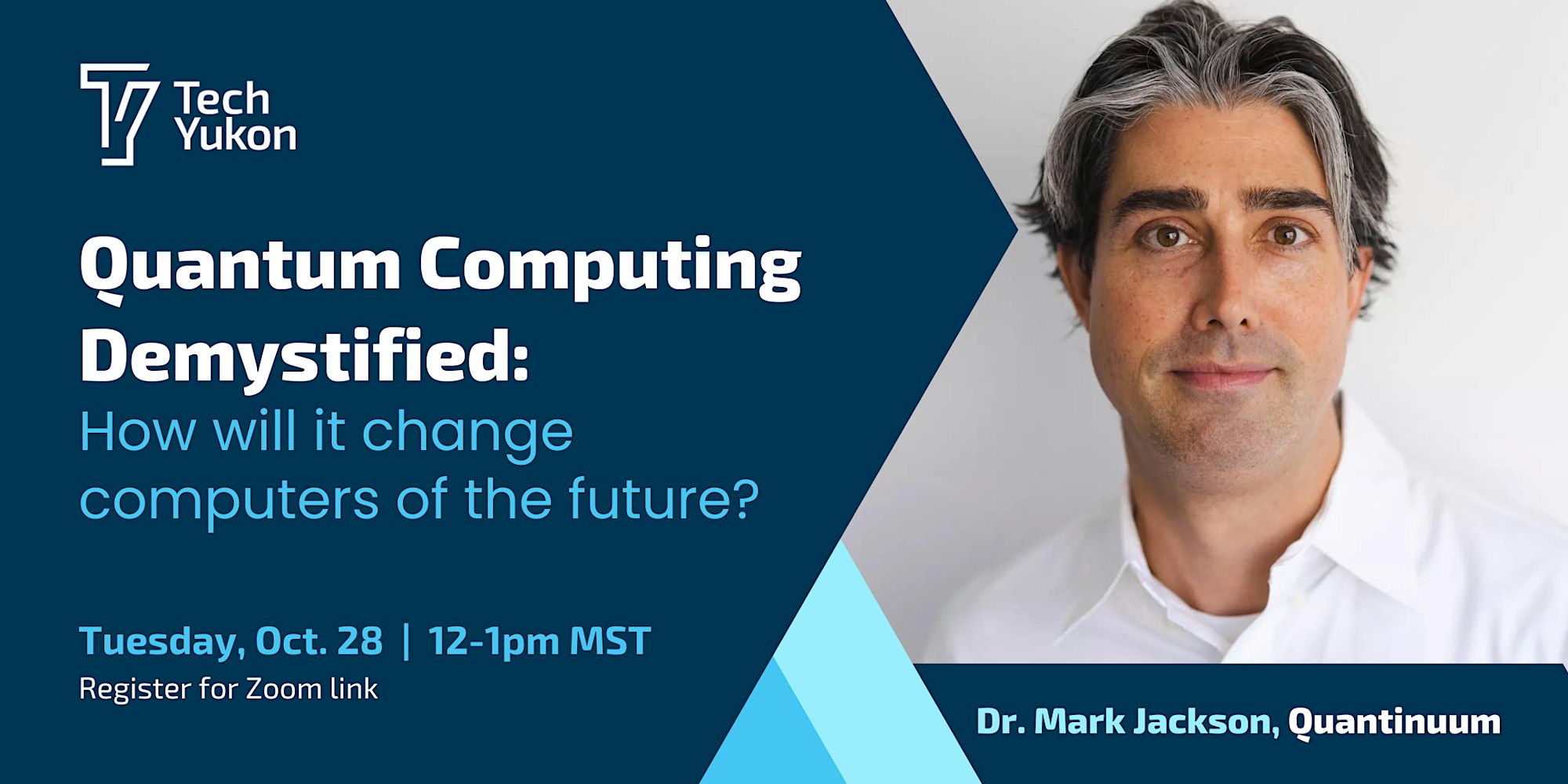


On October 28th, we had Dr. Mark Jackson from Quantinuum provide an insightful presentation on how quantum computing works, the current state of the technology, and meaningful applications + how it’s poised to revolutionized many industries. Here’s the recording:
Here is a summary:
Quantum Computing Demystified
Quantum Computing is Fundamentally Different: Quantum computing (QC) is not just a faster version of a classical computer. A supercomputer is the same type of computer as a laptop, just “more of it”. A quantum computer, however, is built and structured completely differently.
• Reality, Not Fantasy: QC is already a reality and is being used by many people and groups. For example, Quantinuum’s compiler, TKET, has had over 2 million downloads, indicating widespread early adoption.
• Overcoming Classical Limitations: Classical computers (which use switches/transistors that are either on or off, or bits) are conceptually identical to the first computer built by Charles Babbage. They cannot solve complex simulation problems; for instance, simulating a caffeine molecule would require a computer the size of a planet, and simulating penicillin would require a computer the size of the observable universe.
• The Quantum Leap (Simultaneous Calculation): QC represents the first advance in how computers are built and how calculations are performed in human history. Unlike a normal computer that must try every possible solution sequentially, a quantum computer is capable of considering all solutions simultaneously.
How does it work?
Quantum computers use qubits (quantum bits) which have 2 special characteristics:
- Superposition: A qubit can be both zero and one at the same time until it is measured.
- Entanglement: Qubits can be correlated, which Einstein referred to as “spooky action at a distance”.
Qubit Representation: The combination of superposition and entanglement allows qubits to represent many different configurations or solutions for a given problem.
How are Qubits applied in computing?
- Superconducting Technology: Used by IBM and Google; often recognized by the “golden chandelier” appearance.
- Ion Trap Technology: Used by Quantinuum; cubits are charged atoms (ions) physically moved around, with lasers used to change their value (superposition and entanglement). This approach is currently considered the most promising.
- Cold Atom Technology: Qubits held in place using lasers.
- Photonic Technology: Qubits using photons (light particles).
Progress in the advancement of quantum computing technology is measured by increasing the number of cubits and improving the fidelity (reducing the error rate).
Current Technology Status:
- Superconducting technology currently has about 1,000 cubits but has a high error rate, often not surpassing the threshold needed for quantum error correction.
- Ion trap technology has fewer cubits (about 100) but a much lower error rate, suggesting an easier path toward the goal of many high-quality, quantum error-corrected cubits.
Quantum computing is on a much faster growth trajectory than classical computing (Moore’s law, which involves doubling performance every 18 months). Quantum progress has shown about a 10x increase every year over the past five years. Based on this trajectory, practical applications are expected within the next year.
Immediate and Future Real-World Applications
Chemistry and Pharmaceuticals (High Impact): QC is expected to solve chemistry problems impossible for normal computers, needing only a few hundred cubits to do so.
- Drug Discovery: Current drug development is very inefficient, with a 99.9% failure rate, taking 10 years and $1 billion per drug. QC simulations can identify the best possible drug molecule, potentially leading to personalized medicine.
- Fertilizer: Currently, the most valuable chemistry problem is fertilizer production, as the Haber-Bosch process is energy-intensive and environmentally harmful (using about 2% of the world’s energy supply). QC could simulate the chemical reaction used by bacteria to generate fertilizer, allowing humans to mimic a more efficient process.
Finance: Financial groups (like JP Morgan and Wells Fargo) are interested in using a quantum Monte Carlo algorithm, which is quadratically faster than classical computing, to conduct simulations and anticipate stock market behavior more accurately and efficiently.
Materials Science: QC can simulate processes like superconductivity to understand them better. This could lead to building better superconducting materials that work at higher temperatures, enabling advances in technology such as higher resolution MRI machines (to for instance, improve cancel cell detection), better battery technology, and improved fuel cells.
Quantum AI (QAI) and LLMs: Quantum is expected to play an essential part in AI. Because normal AI is limited by what classical computers can calculate, QAI is necessary to overcome these limits.
- Nvidia has already partnered with quantum companies and established a quantum research center.
- Quantum versions of LLMs (Natural Language Processing or NLP) are expected in a few years, allowing for more nuance and subtlety because the system is not strictly limited to ones or zeros.
- QAI can also be applied to non-human languages, such as genetic sequences (e.g., in work with Amgen) or music.
Cybersecurity: Threats, Defenses, and Timeline
- The Quantum Hacking Threat: In 1996, Peter Shor developed a quantum algorithm that could factor numbers very efficiently – the math underpinning about 99% of internet encryption. As quantum computers have become powerful in recent years, this is now a threat. It may be possible in as soon as five years for quantum computers to hack most of the encryption on the internet.
- Post-Quantum Encryption (PQC): New forms of encryption have been developed based on mathematical formulas that quantum computers cannot hack. Three winning formulas have been announced. Companies like Google, Apple, Zoom, Signal, Cloudflare, and Thales are already integrating PQC into their cyber security.
- Quantum Prevention (QKD): QC can also be used to prevent hacking. Quantum data transmission (usually via fiber optics or lasers) is secure based on the laws of physics. Because observing a quantum state changes it, any eavesdropping attempt (intercepting and measuring a qubit) will break the entanglement and be detectable by the communicating parties (Alice and Bob).
Cryptocurrency Note: Quantum computers cannot be used to mine Bitcoin or other cryptocurrencies, but if the crypto uses old encryption, it could be hacked, necessitating an upgrade.
Call to Action
Businesses are encouraged to start thinking about how quantum can help their industry because if they are not, they are already behind. Recommendations include:
- Upgrade Encryption Now: Due to Moscow’s inequality, groups should upgrade their encryption to post-quantum encryption immediately, considering the time it takes to transition versus the time the data needs to remain secure.
- Start a quantum readiness team to encourage understanding and exploration of the technology.
- Consider testing projects with a quantum computing company to understand how QC will affect the industry.